A Measurement-Based Care Guide That Centers Care

Measurement-Based Care (MBC) is becoming a requirement in behavioral health. Nevertheless, providers often see MBC as something that is 'good in theory,' but terrible in practice. This is because its implementation is often burdensome, overly administrative, and experienced as deficient in utility or meaning.

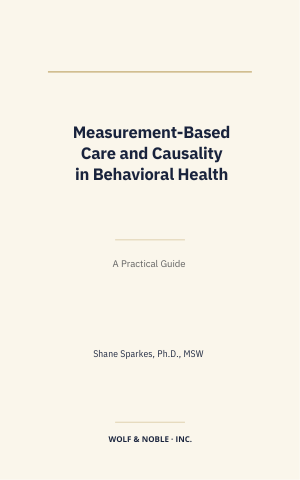
'Measurement-Based Care and Causality in Behavioral Health: A Practical Guide' by Shane Sparkes, Ph.D., MSW addresses this problem by offering an MBC that is built from the ground up for behavioral health providers. As a working clinician and statistician, he understands that providers and clients are already experts. Measurement should therefore serve as a translation of their understanding and intrinsic sense of measure: not as a focus of care that eats up time, but as an additional tool for decision-making.

Purchase this book to obtain an accessible, care-centered guide on measurement theory, MBC, the analysis of treatment effects, and reasoning under conditions of uncertainty. No special background is required. Bring a willingness to think and model visually, both fast and slow. This is the only pre-requisite. Join the movement to bring a care-centered MBC to the forefront!

Access a Guide for Providers by Providers

A Comprehensive Resource for Practitioners

"Measurement-Based Care and Causality in Behavioral Health" is a ~250-page practitioner's guide that takes you from measurement theory to causal reasoning across six structured chapters: an introduction, the philosophy and four schools of measurement, measurement-based care across the full assessment–intervention–termination arc, Bayesian reasoning for clinicians, causal inference with directed acyclic graphs (DAGs), and a capstone chapter integrating all three. Every chapter opens with stated learning objectives and an overview and closes with a summary, so you always know what you're building toward. Along the way you get 60 distilled key takeaways, 41 worked clinical examples, 29 hands-on assignments that turn theory into repeatable practice, and 24 figures and DAGs that make abstract concepts visible. Rounding it out are clinical vignettes, key-terms boxes, a full glossary, a notation-and-symbols reference, and a complete index — a self-contained toolkit for any behavioral health provider who wants to measure what matters, reason under uncertainty, and make their causal thinking explicit at the point of care.

A Snapshot of Key Features

A six-chapter guide that turns measurement theory, Bayesian reasoning, and causal inference into point-of-care practice for behavioral health providers. Perfect for graduate courses and organizational implementation.

At-a-glance stats

  • 6 structured chapters, ~250 pages
  • 60 key takeaways
  • 41 worked clinical examples
  • 29 hands-on assignments
  • 24 figures and causal graphs
  • Learning objectives, overview, and summary in every chapter
  • Glossary, notation reference, and full index

Transformative Framework Highlights

  • Enhanced Clinical Decision-Making

    Learn how formal measurement theory and modern causal inference already relate to your daily practice. In every encounter, you are already measuring your client's disposition and making decisions about what interventions will bring about the best effect. Take it to the next level.

  • Client-Centered Approach

    Discover idiographic scales and self-standardized tools that honor individual client experiences. Validated scales are useful and important, but they are not the fundamental way that we measure what is present in our encounters. Rediscover and formalize what you already have mastered.

  • Rigorous Reasoning Tools

    Gain competency in the use of Bayesian reasoning and directed acyclic graphs (DAGs) for case formulations, treatment planning, and decision-making. Learn about a class of treatment effects that you can often reason about, and even if you do not keep track of all background factors. Minimize formal measurement; maximize impact.

About the Author

Shane Sparkes, Ph.D., MSW is a clinical social worker with over a decade of experience serving individuals with serious mental illness and co-occurring disorders, both in residential and field-based settings. He is also a statistician with a Ph.D. in biostatistics from the University of Southern California who labors at the intersection of phenomenology, measurement theory, and causal inference. As the founder of Wolf & Noble, Inc., he is dedicated to developing a form of measurement-based care that empowers providers and clients, and that also makes behavioral health services more transparent and accountable.
Author image of Shane Sparkes

Empower Your Clinical Practice Today

Take the next step towards enhancing treatment efficacy while preserving the authentic therapeutic core of behavioral health care. Download your PDF and EPUB copies now!

Or Purchase in Paperback or Hardcover Form on Amazon!

Click the image below.